
Las Garillas
Number of claims: 10
Area: 2,000 hectares
The Las Garillas and Carmona properties are part of the Central Cretaceous – Palaeocene Copper-Gold Belt, which is famous for hosting some of the world’s largest deposits which are characterized by their size and longevity of production.
Overview
Strategic Location
Las Garillas is located approximately 308 km north of Santiago, Chile and situated within a well-known metallogenic belt in Chile, known for significant deposits and mining activities. This region is historically rich in minerals and hosts several large-scale operations, offering a beneficial environment for further exploration and potential development.
Geological Potential
The property has high sulphidation epithermal veins as well as porphyry, and skarn type deposits. These deposit types are significant for their potential to host economically viable quantities of minerals such as gold, silver, and copper.
Infrastructure
The property is accessible year-round with existing infrastructure supportive of ongoing exploration and potential future development.
Extensive Exploration Work
Exploration activities include stream sediment sampling, soil sampling, rock sampling, and geophysical surveys (resistivity and IP). A comprehensive drilling campaign also yielded significant data, underpinning the potential for discovering mineral resources.
Positive Results
Recent exploration in the 4 – 5 km2 Oro Brillante sector identified high-grade vein swarms grading 1.2 -61.4 g/t Au.

As seen in Figure 1, most of the project area is underlain by granitic rocks while portions of the east side the property are underlain by a volcano-sedimentary package of pyroclastic volcanics and sandstone.
Shown in Figure 2, 183 surface rock samples were collected through the property, 142 assayed at or above the detection limit. The highest gold assay was 46.0 g/t Au, with an average gold grade of 1.66 g/t Au.

Exploration
- A five line, 5,800m geophysics campaign was carried out between January and February 2024.
- The methods used were electrical resistivity and induced polarization. Lines were parallel to each other, orientated north-west/south-east.
- Utilizing the results from the IP Surveys, a 5-hole, diamond drill program commenced in April 2024.
- Each drill hole reached a depth of approximately 300-metres, after which the core was extracted and then cut for analysis.
- The lithology found in the drill cores included granodiorite phases, volcanic rock, various dykes and alteration minerals.
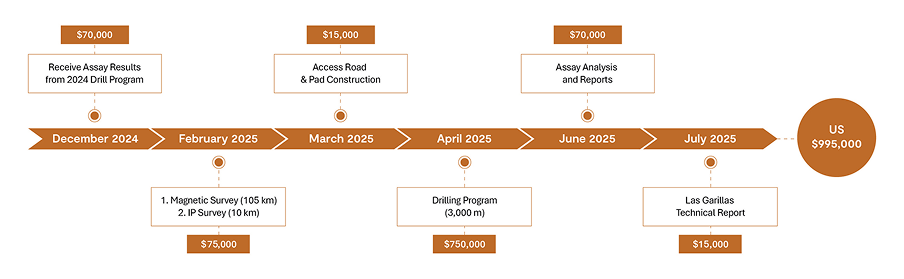
- In December 2024, Kairos received the assay results, providing key insights into the mineral content and potential value of the deposits.

Results
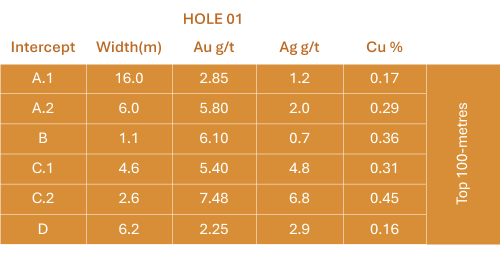
In 2024, a 1,500-metre 5-hole diamond drill program was completed to evaluate the surface and subsurface geophysical targets identified to date. Notably:


Holes 01 & 02 were drilled perpendicular, with hole 02 intercepting hole 05. Notable results from the assays include:


Timeline